
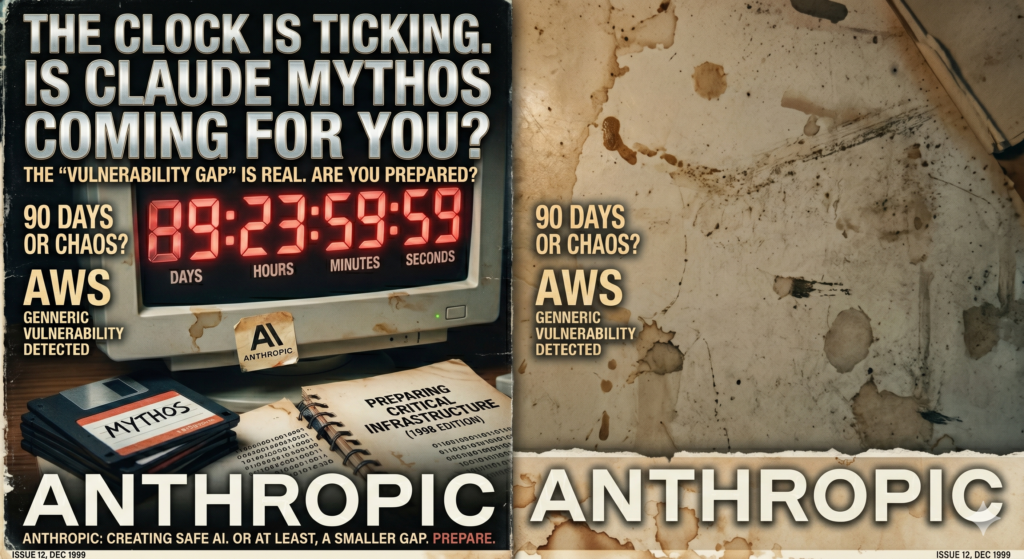
Anthropic’s April 7, 2026 launch of Claude Mythos Preview wasn’t framed like a normal model release. It was framed like an emergency. The company said it had built a general-purpose frontier model so effective at discovering software vulnerabilities that it couldn’t responsibly make it widely available. Instead, Anthropic launched Project Glasswing — a partnership with AWS, Apple, Cisco, CrowdStrike, Google, JPMorganChase, Microsoft, NVIDIA, Palo Alto Networks, and more than 40 other organizations that build or maintain critical infrastructure. It committed up to $100 million in usage credits, $4 million in open-source security donations, and promised a public report on lessons learned within 90 days.
The headline temptation is to call this a Y2K moment — a countdown clock where companies have 90 days to fix vulnerabilities or have their software exposed to super-intelligence fueled exploits. But the real story is subtler and, in some ways, worse. Mythos doesn’t create a single deadline. It threatens to open a gap — between the speed at which serious software flaws can now be found and the speed at which anyone can actually fix them. That gap is the thing worth watching. It shapes each of the four big questions Mythos raises.
Time to X-Day
Y2K was a calendar cliff: one date, one failure mode, one global countdown. Mythos is not like that. Anthropic’s coordinated vulnerability disclosure framework is deliberately elastic: a 90-day standard window, a 14-day extension for maintainers actively working on a fix, a compressed 7-day timeline for bugs already being exploited in the wild, and a 45-day waiting period after a patch before publishing full technical details. This closely mirrors the disclosure norms that Google Project Zero helped establish.
But the absence of a cliff doesn’t mean the absence of danger. Anthropic says fewer than 1% of the vulnerabilities Mythos has surfaced have been fully patched so far — in part because the company is deliberately pacing its submissions to avoid overwhelming maintainers. When a maintainer doesn’t respond within 30 days, Anthropic escalates through an external coordinator and moves toward disclosure on the relevant timeline.
What happens when someone misses a window? Usually not instant catastrophe. But each missed window raises the odds that a vulnerability enters the defender ecosystem — and then the attacker ecosystem — before the fix is widely deployed. In cybersecurity, “patched” and “safe” are cousins, not twins.
This is where the gap bites hardest. Before Mythos, the bottleneck was finding severe bugs. Now the bottleneck is everything that comes after: validation, remediation, testing, rollout. The discovery engine got a jet engine which fixes cannot keep up with even with the benefit of ai coders.
Glasswing partners get access to Mythos for defensive security work — not a blank-check preview for every business use case. But Mythos is a general-purpose model, and Anthropic’s own benchmarks show significant gains over Opus 4.6 on coding and agentic tasks, including SWE-bench Pro, Terminal-Bench 2.0, Humanity’s Last Exam with tools, and OSWorld-Verified.
Second Order Effect of Project Glasswing: Moat Building for the Haves.
That means the real moat isn’t just “find more bugs.” It’s organizational learning. Partners get time to build agent scaffolds, triage pipelines, black-box testing workflows, internal evaluations, and patch automation around a model that is clearly more powerful than its predecessor. Microsoft said Mythos showed substantial improvement on CTI-REALM, its open-source detection-engineering benchmark. Palo Alto Networks said the model was already identifying complex vulnerabilities that previous-generation models missed entirely.
Anthropic’s own economic research helps explain why this early access compounds. In March 2026, the company reported that more experienced Claude users attempt higher-value tasks and are more likely to get successful results. An earlier report found that “directive” conversations — where users hand Claude a complete task rather than collaborating step by step — jumped from 27% to 39%, indicating a shift toward more autonomous workflows. Better users get more out of the model. Firms that start earlier learn faster. A 90-day lead with Mythos is not just a capability advantage. It’s a knowledge advantage, and knowledge advantages compound.
Here the gap reappears in a different form: the gap between organizations that are learning to work with frontier AI and those that are still waiting for access. The first group is building muscle. The second group doesn’t yet know which muscles matter.
Countdown to an Open-Source Mythos
History suggests closed-model leads don’t last forever — and lately, they haven’t lasted long. GPT-4 launched in March 2023. By July 2024, Meta was releasing Llama 3.1 405B, which Meta’s own materials said outperformed many open and closed models on common benchmarks. By January 2025, DeepSeek-R1 was claiming performance on par with OpenAI-o1 and releasing weights, code, and distilled variants under MIT. The 2026 International AI Safety Report puts the broader trend bluntly: the best open-weight models now lag the best closed models by less than one year.
Security-specific catch-up may be slower. Anthropic says Opus 4.6 had a near-zero success rate on autonomous exploit development, while Mythos was suddenly developing working exploits at far higher rates and chaining vulnerabilities more effectively. A reasonable estimate: open-weight models could plausibly reproduce important slices of Mythos’s reasoning and coding strengths in 6 to 12 months, while the full “agentic cyber operator” stack — autonomous discovery, chaining, and exploitation — may take 12 to 18 months to become broadly available. That timeline is also consistent with METR’s finding that frontier AI task horizons have been doubling roughly every seven months since 2019.
When open-weight models catch up, the gap between finding and fixing will widen dramatically. The International AI Safety Report warns that open-weight safeguards are easier to remove, usage is harder to monitor, and released weights cannot be recalled. Cheaper autonomous vulnerability discovery, faster exploit iteration, and fine-tuning by actors outside normal governance frameworks — all of it arrives at once. If Mythos is the locked prototype, open-weight catch-up is the moment the blueprint hits the sidewalk.
The defender’s gap — already strained — becomes everyone’s gap.
Real Danger or an Antrhopic Marketing Stunt?
Anthropic absolutely benefits from announcing a model that is simultaneously “our most capable” and “too risky for general release.” The framing generates headlines, creates an elite-partner halo, and builds the mystique of having crossed some forbidden threshold. The rhetoric isn’t separate from the branding. It is the branding.
There’s clear precedent. In 2019, OpenAI used a staged release and partnership-based sharing strategy for GPT-2, explicitly saying the goal was to give the community time to assess implications. Months later, the full release happened and OpenAI described the episode as a test case for responsible publication. Mythos follows the same template. The safety narrative and the publicity flywheel were intertwined then, and they are intertwined now.
But “this is also marketing” doesn’t mean “the capability jump is fake.” Anthropic has published specific performance deltas, exploit anecdotes, a detailed disclosure framework, and an acknowledgment that many of its strongest claims are hard to independently verify because most discovered bugs remain undisclosed and unpatched. The 2026 International AI Safety Report, for its part, warns about an evaluation gap — benchmarks and pre-deployment tests often fail to predict real-world behavior. So skepticism is warranted. But the same evaluation gap means the danger could be larger than advertised, not just smaller.
The fairest read is that Mythos is both things at once: a genuine leap in capability, and a carefully staged performance around that leap. The two are not mutually exclusive. In fact, the performance is only possible because the fire is real.
The Bottom Line
Claude Mythos is not Y2K. There is no single date on which the sky falls. What Mythos represents is something more structural: a future in which discovering severe software flaws becomes dramatically faster than remediating them. That gap — between the speed of the break and the speed of the fix — is the thread connecting every question Mythos raises. It’s why the disclosure treadmill matters, why the Glasswing lead compounds, why open-weight catch-up is dangerous, and why the marketing spectacle doesn’t cancel the underlying risk.
If Anthropic is right about the capability, the 90-day Glasswing window is a defensive head start for the partners inside. If Anthropic is also marketing hard — and it is — that doesn’t make the head start imaginary.
In cybersecurity, the loudest alarm is sometimes attached to the hottest fire.